2014년 10월 26일 일요일

October Week 3


     S&P 500 sparked up 4.24% this week with bright light from eurozone and China. China showed a stronger GDP than its forecast; it inclined by 7.3% YoY (forecast 7.2%). It shows that global economy in Q3 was stronger than what the market saw. The strong GDP implies that the world economy will rebound back in the following time period, which increases investors expectations along other issues. In the market on Tuesday, there was a rumor that the ECB will purchase corporate bond, which later claimed that it is not confirmed 'yet.' But this rumor was huge enough to impact on the market.

      Within the U.S. market, several companies showed unexpectedly positive earnings, which led to an increase of S&P 500. The UPS, Catapillar, Boeing Inc, Apple and P&G all showed high earnings while IBM, Amazon Coca-Cola and McDonald had an below-expected earnings. But those large companies with high earnings, low gas price, stabilizing job market and CPI led a market this week.


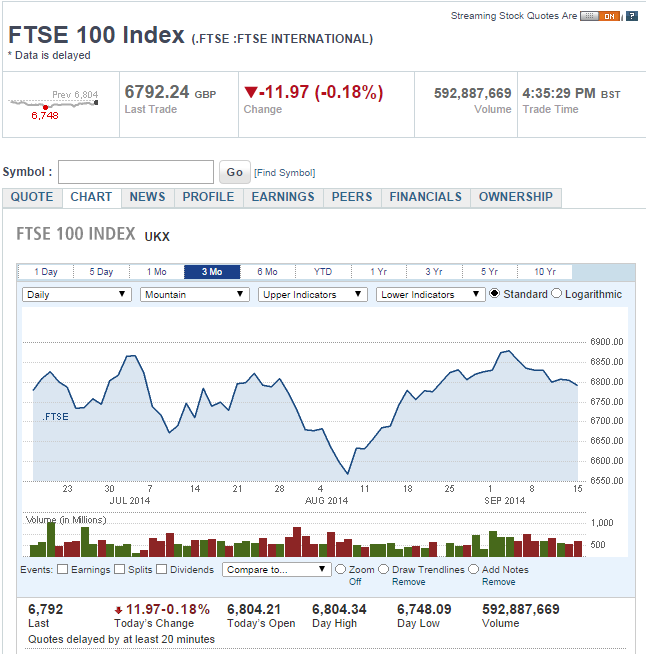
      Europe had a good week; the DAX increased by 2.03%, FTSE 100 for 1.38% and CAC 40 rose by 3.15%. Like the U.S. market, the EUwas affected by China GDP and rumor of the ECB corporate bond purchase. Along that, strong PMI in Germany and EU led the market this week. The markets finally started to bound back.

     Last week, one of the reasons EU markets declined was from Germany that its ZEW Economic Sentiment unexpectedly fell down (actual was -3.9 compared with 6.9 previous month). Yet this week Germany showed a strong PMI of 51.8 (forecast 49.5). The EU Manufacturing PMI was 50.7, which was also higher than the forecast of 49.9. Those strong economic indicators led the market increase. Also U.K. GDP resulted as 3.2% increase in this quarter, which is declined by 0.2% from previous quarter. Yet this 3.0% increase still meets the government target, it had a limited affect on the market this week. With stabilizing housing price and retail sales, U.K. market seemed to follow EU economic sentiment.


     This week's global issue came from Asian market. The above-expected China GDP helped the U.S. and Europe but not Asian markets.


     The Shanghai Composite Index declined by 1.87% this week as the strong GDP and labor market suggested less government stimulus in the market. The reason the Chinese government considered additional stimulus in the market was they were worried about slow economy, especially in manufacturing sector and real estate market. Yet the strong GDP and labor market, and high PMI shows that the Chinese economy is doing much better than that they thought. As the expectations faded away, the Shanghai Composite Index declined with positive economic indicators.


     EUR/USD unchanged this week, and USD/JPY increased by 1.26%. The Japanese prime minister, Abe Shinzo, stated this week that they might postpone sale-tax increase. Along with the current government policies, it had a positive impact on the market to depreciate the JPY.
 

2014년 10월 18일 토요일

October Week 2


     S&P 500 declined by 1.13% this week. It hit the new low of 200-day average of 1,882.99 on Wednesday as German Economic Sentiment significantly declined due to continuing geopolitical risks from Russia and Ukraine, and Drgahi's speech that it is unlike to implement quantitative easing in a short period. Even the ECB is exercising ABS program, but it is hardly affecting the market. The other reason is decline in oil price. The price of crude oil declined by almost 30% compared with its peak 3 months ago. It had the largest drop of 3.76% on Tuesday. There are high supplies of oil as OPEC expected high economic growth in the third quarter. But the reality is that Europe and China are still suffered from recession that the demand of oil far behind than what they expected.


     Speaking of the European market, there was no sign of improving. The ECB expected the bank to increase money supply by purchasing bad assets, the ABS program, but there was no significant impact on the market. In the past, the market continuously improved with poor economic data is that the investors expect the ECB to implement actual quantitative easing. As the expectation faded away, the investors were afraid of higher deflation risk, as EU CPI stagnated even after the ABS program.


     However, there was bounce back at the end of the week as positive economic data came from the U.S. market. It showed that U.S. economy is still improving with high consumer spending, and strong housing and labor market. The stronger USD also explains that there are more investors involved in the market. The most important issues were speech from the president of the Deutsche Bundesbank, Dr. Weidman, and the president of Federal bank OF St. Louis, James Bullard.

     The president Weidman stated that the deflation risk in Europe is temporary from the low oil price. Even he disagreed with the quantitative easing, his speech was good enough to ease tensions in the market. President Bullard stated on Thursday that the Fed. should delay the quantitative easing. Since the Fed. considered to exit the quantitative easing last meeting, his speech strengthened the market.


     Despite global deflation risk, especially Europe and Japan, China's market is outperforming other countries. The main reasons are recent quantitative easing implemented by the PBOC and high demand of goods from the U.S. consumers. The manufacturing sector of China is also boosted by low commodity price. Even the low commodity price implied the low demand of goods, but it is a good news of China as they can get the resources with lower price. Besides, the investors expect more stimulus from the central bank as its CPI and estimated GDP are below the target.

2014년 9월 27일 토요일

September 26, 2014


Two major issues pulled DJI up for 0.99% today. Corrected U.S. GDP and Michigan Consumer Sentiment proposed strong economic growth. The 4.6% growth GDP was mainly dragged by high consumer spending, which increased by 2% compared with 1.4% growth in Q1, as consumers gain confidence back.

Notice that nonresidential fixed investment increased by 9.7% compared with 1.6% in Q1. It highlights that companies are willing to invest more as the economy gains its strength back. Yet there is a concern that this significant increase was due to weather. It rises a question whether companies are still willing to invest during Q2 and Q3.

Michigan Consumer Expectations was above expectation. It highlights that consumers are still looking at the bright side of economy and willing to consumer. Along with recent strong labor market data, it brights the U.S. economy.


Recently Nikkei continuously increased as additional stimulus was expected. Japan still suffers from inflation rate. National Core CPI decreased by 0.2% YoY from last month, arises a question about the BOJ's monetary policy. Since low inflation rate policy is not working well, market expects larger stimulus package. As a consequence, USD/JPY rate keeps increasing.


2014년 9월 25일 목요일

September 25, 2014


DJI declined by 1.54% with increased geopolitical issues and fear of increase interest rate in England. Russian parliament proposed a bill on foreign-asset freeze. The court would have the right to go after foreign states' asset in Russia, including property under diplomatic immunity.

Yet it is unlikely that the government of Russia will approve this bill since it will bring diplomatic chaos. It still effects on the market because Ukraine issue recently eased that neither Russia and E.U. proposed additional sanctions on each other. Today's bill suggests that both Russia and E.U. may implement additional sanction which will eventually hurt the economy.

As a result, DAX declined by 1.54% today. Russia is the largest export partner of Germany and manufacturing takes about 22% of its GDP. As geopolitical issues with Russia arises, DAX is easily fluctuated. Besides, German manufacturing PMI declined more than forecast. They signal red light on German economy in Q3.


BOE Governor Mark Caney states today that "with many of the conditions of the economy to normalize now met, the point at which interest rates also begin to normalize is getting closer." As a result, besides with issues from Russia, FTSE declined by 0.99%
Gov. Caney mainly concerns about inflation rate, housing and labor market to determine the "normal" interest rate.

   
Halifax house price index declined in August, suggesting that housing market is cooling down. However it is still at the record-high price that the price has to be adjusted before the market overwhelmed. CPI is stabilized yet underscores the target, 2%. Unemployment rate keeps decreasing that suggests labor market is getting stronger.

High housing price, below-target CPI and strengthening labor market combined to increase the interest rate sooner. Keep in mind that service industry takes about 79% of U.K. GDP. Sudden increase in interest rate would harm its economy.


Gold increased slightly (0.11%) and Euro still weakens as geopolitical issues arises and ECB would implement QE in a short term.

2014년 9월 20일 토요일

September 19, 2014


There were several outstanding issues last three days:
1) Rejection of Scotland independence
2) Relief from FOMC meeting
3) ECB's targeted long-term refinancing operations (TLTROs, $106.9 billion)
4) Alibaba IPO

I apologize for the late update.


DJI boosted with Alibaba's successful IPO. It gave a positive view on the market on Friday. Yellen 's speech after FOMC meeting also gave a positive look on the market that it is unlikely to increase interest rate anytime soon. She stated that housing market is improving but it is still a concern for economic recovery for low income families.

The market still needs to consider that interest rate will be increased. The reason why Fed. didn't increase the rate, or even consider to increase this time, is they are worried about overreaction in the market. As market accepts that the rate will be increased, sooner than they think, the Fed. will take action.

Yellen's statement today came out along with decrease in continuing jobless claim and building permits. Since the main cause of financial crisis came from the housing market, recession in housing market rises concern on economic expansion. Housing market is still the important asset channel for low income families. Jobless claim continuously decreases, but it doesn't always mean that job market is getting better these days. Yellen stated today that "There are still too many people who want jobs but cannot find them, too many who are working part time but would prefer full-time work, and too many who are not searching for a job but would be if the labor market were stronger." Her statement eased tensions and gave positive look on the market.


Alibaba had a successful debut in the market on Friday. It gave a positive view on the market even though there were some bad economic indicators and increase in geopolitical risks.


As Scotland's independence was rejected and ECB implemented $106.9 billion TLTRO program to enhance the functioning of the monetary policy by supporting bank lending to the economy, it seems like Europe is out from danger zone for now. TLTRO will provide higher liquidity on the market which will increase inflation rate and investment.


Even Scotland's independence was rejected, the U.K. promised to promise extra funding on Scotland. It can potentially harms the U.K. economy, which results as slight decrease in GDP/USD even retail sales increased in August.


Gold price keeps decreasing as global issues are solved and ECB implemented the TLTRO program.

2014년 9월 16일 화요일

September 16, 2014

With lack of significant economic indicator, PBOC released a statement that it will extend its stimulus to $81 billion affects the market. Yet risk from FOMC meeting and Scotland's independent voting on Wednesday still effect on the market that investors take a limited movement in the market.

While it is unlikely that Fed will increase the interest rate at this moment, whether it will keep the "considerable time" on the statement rises on the issues. Even though U.S. households income keeps recovering from 2007-09 recession, a report from the Census Bureau shows that overall income is stagnated last year. Yet it is highly unlike to impact on Yellen's decision since recent payroll and unemployment rate in 2014 shows improvement.
As concern of FOMC meeting rises, 10-year treasury yield increases.

What I concern is that market is very volatile on Fed's decision these days. The Fed needs to take more considerable approach to adjust QE and interest rate.

BOE succeeded to maintain its target inflation rate (2%) while it increased interest rate to cool down housing market. Yet house price increased 1% more than forecast, which alarmed BOE whether how its fiscal policy works in the market.

Investors in FTSE are more focused on Scotland's independent news that it did not show a significant movement.
There was significant GBP/USD change in last few days as the issue of independent came out. Even though many investment bailed out from U.K. market, it is interesting that FTSE is stagnated at the same period.

2014년 9월 13일 토요일

September 12, 2014

     DJI declined by 0.36% as investors worried about FOMC meeting on next Tuesday and Wednesday. Even though it is unlikely to increase interest rate at this point of time, the Fed. expects to increase the interest rate sooner rather than later as labor market keeps improving.
The Dow Jones declined 0.64% as the fear of higher interest rate rose. Yet strong economic indicator like high retail sales and industrial production released which bounce the DJI back at the end of the day.
     Increase in retail sales and consumer sentiment mean that consumers are feeling better about economic outlook; economy is more engaged in expansion now. It can be a good news, for now. However, it means that the Fed. is really going to increase the interest rate sooner as it is going to taper the economy.


Unlike U.S., China and EU are experiencing opposite situation.

      China's industrial production declined more than expected this month - the lowest since 2008 financial crisis. Yet the market has a positive responding; its trading volume is high while its price keeps increasing. Investors expect the government to put extra stimulus in the market as the manufacturing sector and housing market slow down.
     If the Fed. decreases the interest rate and U.S. consumer spending is stagnated, China's industrial production will be suffered even more.


     European market declined little bit, but it had a restricted movement. There are too many issues that the investors have to concern at this point. Scotland's independent movement, sanctions on Russia, FOMC meeting and implementation of ECB QE.
     As Russia will propose additional sanctions on EU, DAX declined by 0.41% but other EU companies had a restricted movement. Investors take a wait-and-see attitude rather than taking a movement. ECB changed its attitude on QE recently as Q3 GDP seems to turn positive and deflation risk eased. Yet implementation of QE is still possible as its economy, especially those in Southern Europe are struggling.